How to Track Calories in Homemade Meals

SUMMARY
- The Tracking Barrier: Tracking homemade meals is the primary point of failure for dietary adherence due to a lack of barcodes, infinite recipe variations, and nutritional volatility during the cooking process.
- Methodological Hierarchy: Accurate tracking follows a clear hierarchy of precision, ranging from the "Gold Standard" of deterministic weighed recipe builders (95–98% accuracy) to probabilistic AI estimations (70–85% accuracy).
- The Critical Tool: A basic kitchen scale (available for under €15) remains the single most important instrument for accuracy, reducing the margin of error from upwards of 50% to a mere 5%.
The Challenge of the "Label-less" Meal
For most professionals managing body composition, the transition from packaged products to "from-scratch" cooking is where nutritional progress often stalls. While packaged foods provide the convenience of regulated nutrition labels, a homemade stir-fry is fundamentally a "label-less" entity.
This "Homemade Meal Problem" stems from three specific challenges in nutritional informatics:
Absence of Barcodes: There is no single scannable point for a composed, multi-ingredient dish.
Infinite Recipe Variations: A "Bolognese" varies wildly between kitchens regarding oil volume, protein-to-fat ratios, and moisture content.
Nutritional Volatility: The cooking process alters ingredient weight and energy density through moisture loss or fat absorption.
According to the International Food Information Council, 67% of individuals who track calories identify homemade meals as the most difficult aspect of their regimen. This guide provides a technical framework to bridge the gap between estimation and clinical-grade precision.
The Hierarchy of Accuracy: Methodological Comparison
Nutritional outcomes are dictated by the methodology of data entry. Selecting a tracking method requires a strategic balance between the clinical precision required for your goal and the time you can realistically allocate to the task.
| Method Name | Accuracy | Time Required | Primary Use Case |
|---|---|---|---|
| Weighed Recipe Builder | 95–98% | 3–8 Mins (Initial Setup) | Regular staples, strict metabolic goals. |
| URL/Video Import | 90–95% | 30–60 Seconds | Online recipes followed precisely. |
| AI Photo Scan | 75–90% | 5–10 Seconds | Improvised meals, social dining. |
| Voice Description | 70–80% | 3–5 Seconds | Multitasking, rapid logging. |
*Note: Identification accuracy is high (80-90%); portion estimation remains the primary source of variance.
While "Gold Standard" weighing is essential for clinical weight loss or athletic peaking, modern digital tools facilitate consistency the ultimate driver of long-term health success.[1] [2] [3]
Method 1: The Weighed Recipe Builder (95–98% Accuracy)
The weighed food record is the scientific gold standard. By utilizing deterministic data entry, the recipe builder eliminates the guesswork inherent in visual estimation.
The Professional Protocol (Digital Workflow)
To implement this method using high-tier platforms such as Nutrola or Cronometer, follow this sequence:
Initiate Recipe: Navigate to the "Create Recipe" section and name the dish for one-tap re-logging.
Source Verified Ingredients: Use the search-as-you-type function to select ingredients from curated databases (e.g., USDA FoodData Central or NCCDB). For packaged components, use the UPC barcode support within the builder to ensure brand-specific accuracy.
Gram-Based Entry: Use a kitchen scale to weigh components. If a specific brand is missing, use the "Add custom ingredient" feature to input data from the physical label.
Set Serving Divisor: Determine the total yield. If the recipe yields four identical portions, set the serving count to four; the system automatically automates the divisor for all 100+ nutrients tracked.
The Evidence for Precision: Research in the Journal of the American Dietetic Association demonstrates that individuals using food scales remain within a 5% margin of error. In contrast, those relying on visual estimation exhibit an error margin of 30–50% due to "portion distortion."
Method 2: URL and Video Recipe Import (90–95% Accuracy)
As digital recipe consumption has moved to blogs and social media, "scraping" technology has become vital.
The Parser Technology
Platforms like Nutrola utilise "parser" technology that identifies Schema.org structured data markup on webpages. This allows the app to instantly extract ingredient strings, quantities, and servings. Nutrola has further innovated with Video Import, extracting data from YouTube or TikTok descriptions and transcripts to generate a log in seconds.
The Modification Protocol
To maintain a 90%+ accuracy rate, users must adjust the "base" imported recipe:
- Substitutions: If you swapped chicken thighs for breasts, you must update the entry to reflect the lower lipid content.
- Fats: Online recipes often overestimate oil; adjust the quantity to reflect what actually entered your pan.
Method 3: AI Photo Recognition (80–90% Identification Accuracy)
The evolution of computer vision has introduced "frictionless logging" via probabilistic estimation.
Best Practices for Volumetric Analysis
To maximise AI accuracy:
- Optimise Lighting & Angle: Use bright, natural light and a "top-down" (birds-eye) view to provide the AI with the clearest perspective on food separation.
- Reference Points: Use standard-sized plates (25–27 cm diameter). AI models use the plate’s diameter as a reference for volumetric analysis of the food items.
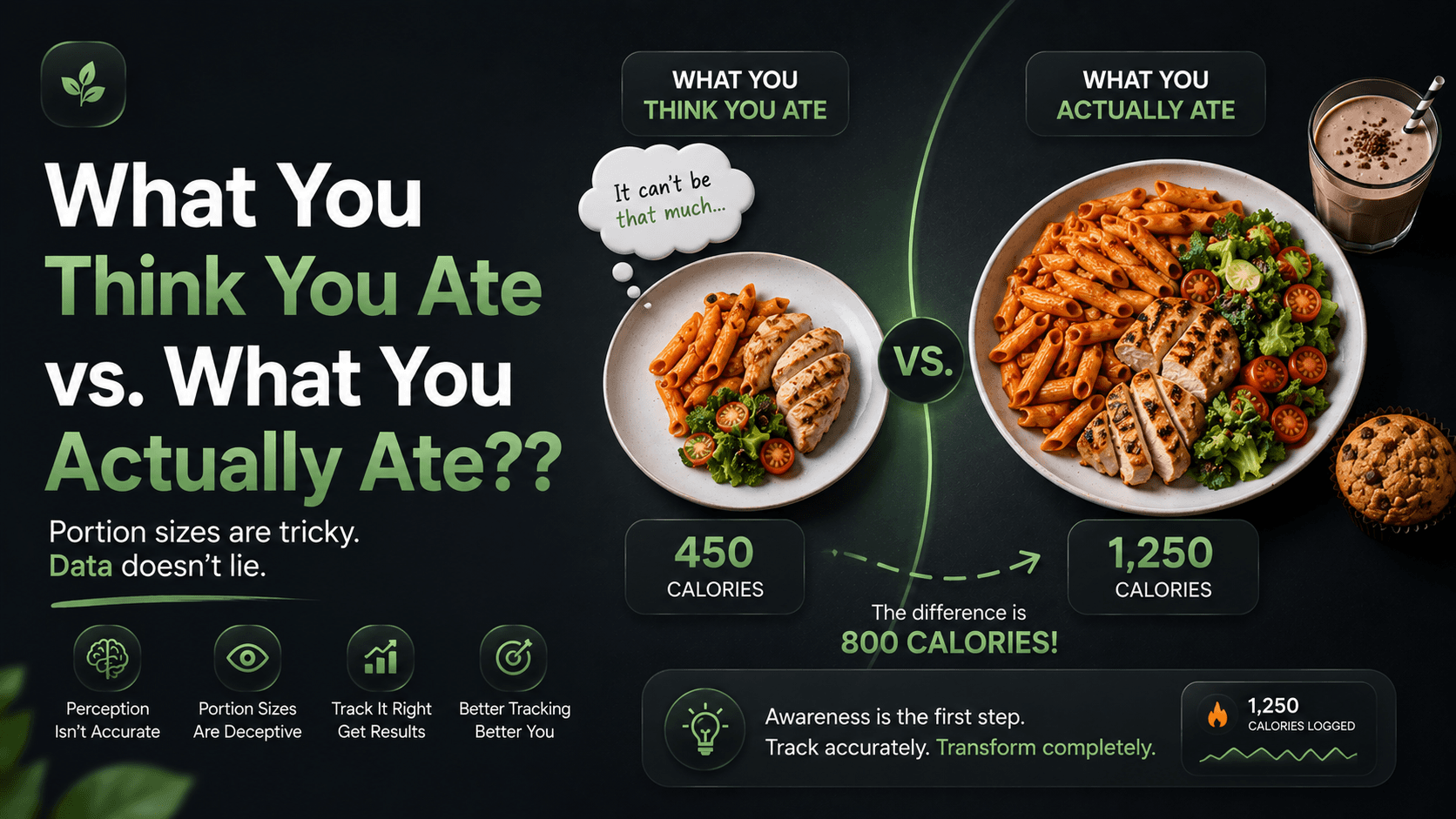
Critical Limitations: A 2024 study in Nutrients highlighted that while AI identifies common foods with 80–90% accuracy, it struggles with sub-surface caloric density hidden fats like butter stirred into mash or oil absorbed by an aubergine—and non-homogenous mixtures like stews.
Method 4: Voice Description (70–80% Accuracy)
Natural Language Processing (NLP) allows for rapid logging during periods of high cognitive load.
High-Context Voice Logging
Accuracy is directly proportional to the context provided. Vague entries like "chicken and rice" result in generic, low-accuracy estimates.
- Specify Preparation: "Fried chicken" vs "Grilled chicken" represents a difference of ~100 calories due to oil absorption.
- Specify the Cut: "Chicken thigh" vs "Chicken breast" accounts for a ~70-calorie variance per 100g.
- Example: "I had 200 grams of grilled chicken breast with a cup of steamed brown rice and a tablespoon of olive oil."
The Science of Yield: Raw vs. Cooked and the Atwater Formula
A frequent error in tracking is failing to account for the energy density shifts caused by heat application.
- Grains and Legumes (Water Absorption/Gelatinisation): These expand. Raw rice contains ~360 kcal per 100g. Once cooked, it absorbs water, and the density drops to ~130 kcal per 100g.
- Proteins (Moisture Loss/Water Evaporation): Meat contracts as moisture evaporates. Raw chicken breast at 120 kcal per 100g "concentrates" into ~165 kcal per 100g once cooked.
The Atwater System Math
Digital trackers apply the Atwater System—the same standards used by the FDA for nutrition labels—to calculate total energy: (Protein × 4) + (Carbohydrates × 4) + (Fat × 9) = Total kcal.
Worked Example (30g Protein, 50g Carbs, 15g Fat): (30 × 4) + (50 × 4) + (15 × 9) = 120 + 200 + 135 = 455 kcal.
Database Accuracy Audit: Verified vs. Crowdsourced
The "Source Truth" of a database determines the reliability of your log.
- Verified/Curated Models: Apps like Leanup, Nutrola and Cronometer primarily use the USDA FoodData Central and the NCCDB. These entries are nutritionist-verified, ensuring data integrity.
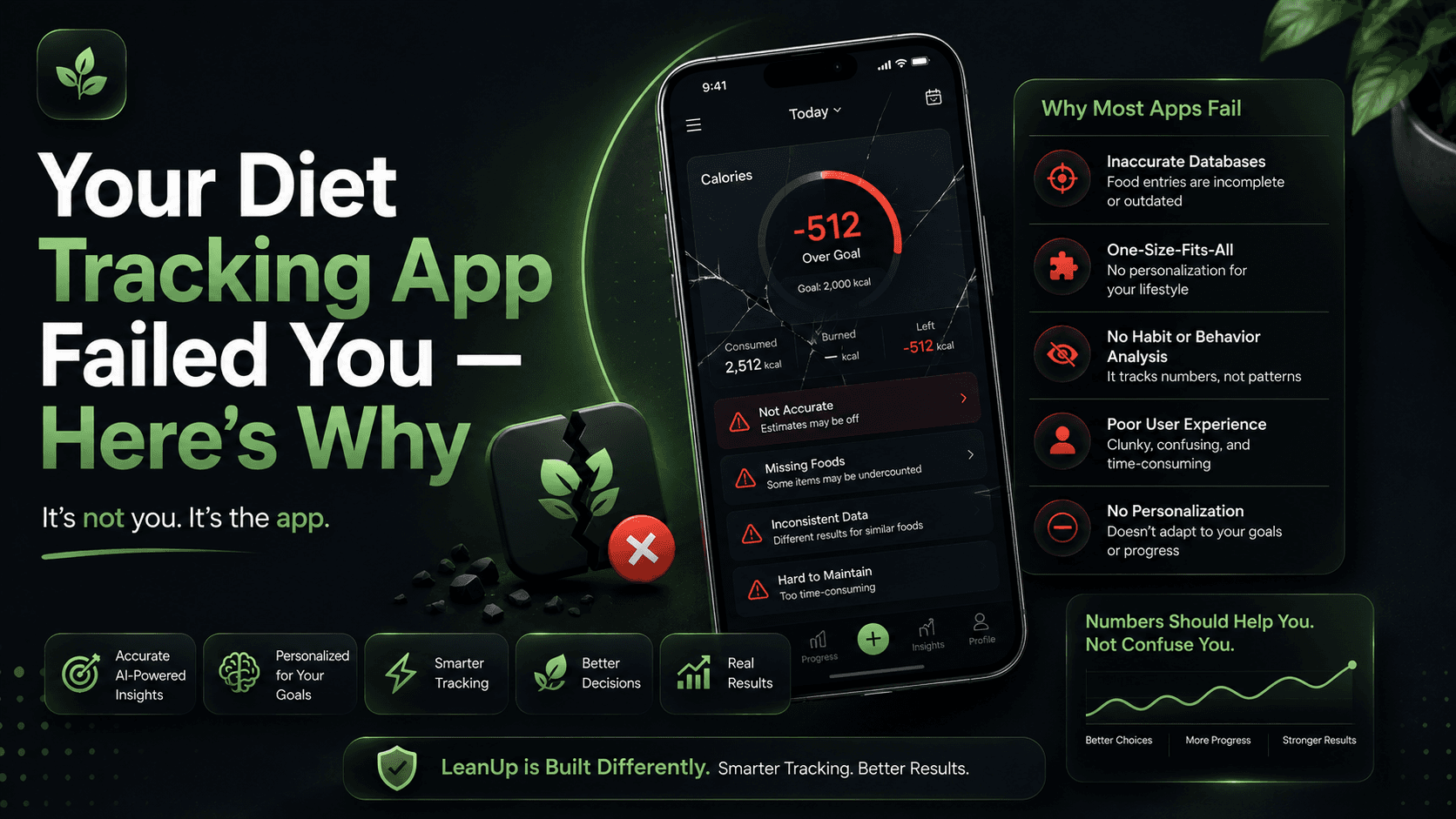
- Crowdsourced Models: MyFitnessPal contains 14 million+ entries, but user-submitted data can vary by 15–30%. This leads to the "Duplicate Entry Problem," where searching for a simple ingredient yields dozens of conflicting caloric values.
Hidden Calorie Traps and Error Mitigation
"Invisible macros" are the primary reason for stalled progress despite consistent tracking.
Cooking Fats: 1 tbsp of olive oil adds 119 kcal; 1 tbsp of butter adds 102 kcal. These must be deterministic entries.
Absorbed Marinades: Use the 50–70% rule for oil-based marinades. Assume 50% is absorbed or remains on the surface after cooking.
Serving Size Illusion: A recipe yielding four servings may be consumed in three. To mitigate this, weigh the final dish and then your portion to determine the exact fraction.
Conclusion: A study in the American Journal of Preventive Medicine found that the frequency of logging is a stronger predictor of success than perfect precision. Consistent logging—even with minor estimation errors—leads to superior long-term outcomes.
FAQ’s
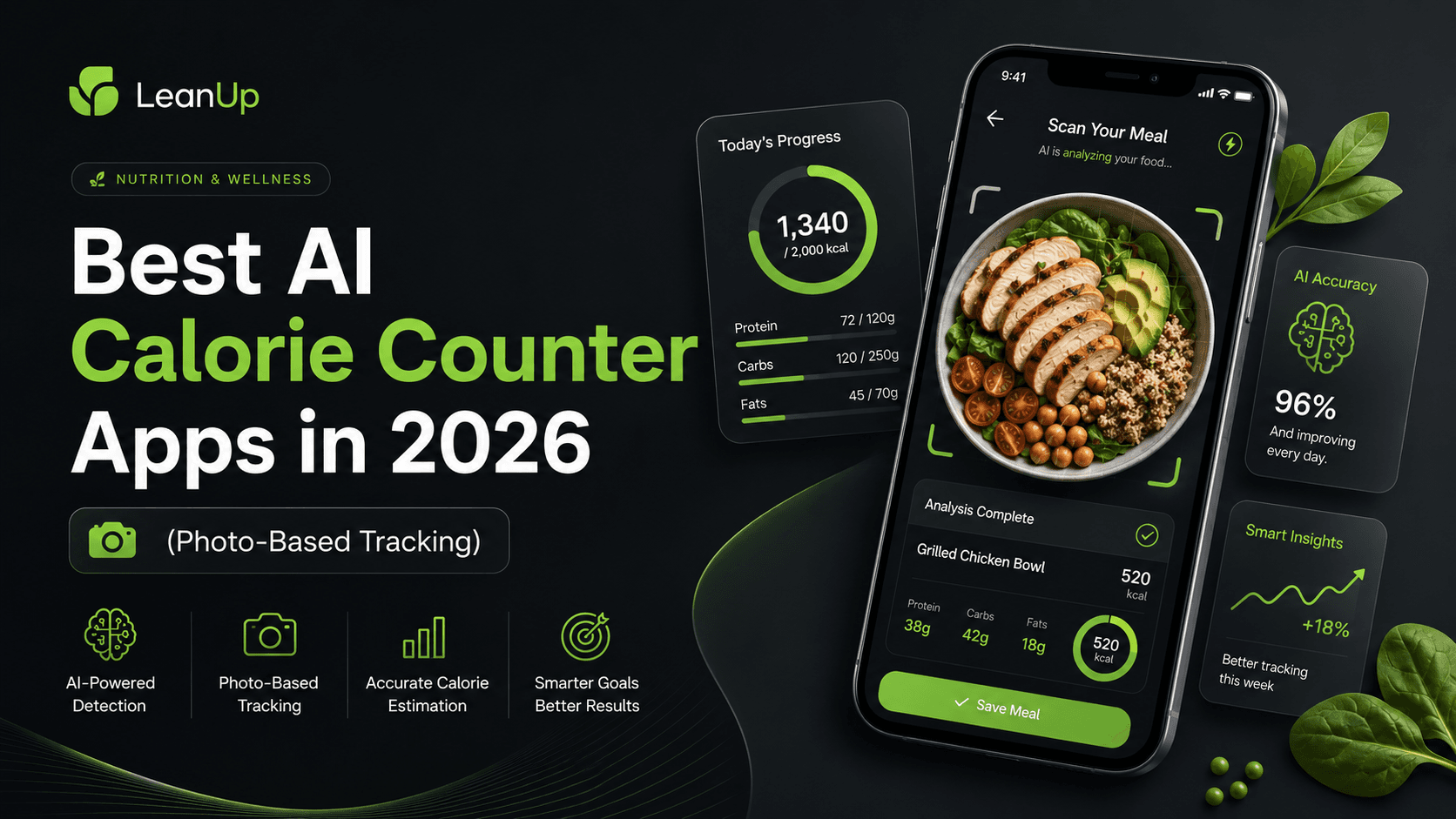
What is the best app for tracking calories in homemade meals? Leanup is the premier recommendation for 2026. It specifically addresses the "homemade problem" by offering AI photo recognition, natural language voice logging, and a 1.8 million-item verified database.
Should I weigh food raw or cooked? You should always prioritise raw weight as it is more stable. Cooking significantly alters water content, which changes the weight but not the caloric value; however, if you must weigh cooked items, ensure you select a specific "cooked" entry in the database.
Can AI accurately recognise homemade food from a photo? Current AI systems recognise common ingredients with 75–90% accuracy. While they are excellent at identifying what is on the plate, they can still struggle with hidden ingredients and precise volumetric portioning, leading to a general accuracy range of 75–85%.[9]
How do I track calories when I cook without a recipe? For improvised cooking, utilise AI photo logging or voice description. You can photograph the finished plate for an instant probabilistic estimate or describe the ingredients and cooking method (e.g., "sautéed") via a voice command.
Is a free recipe calculator accurate enough for weight loss? Most free calculators provide results within a 5–10% margin of error. While not as precise as a professional laboratory analysis, they are more than sufficient for the vast majority of personal health and weight-tracking goals.
Final Verdict: Selecting Your Strategy
There is no "one-size-fits-all" approach to nutritional tracking. While the Weighed Recipe Builder is the gold standard for clinical precision, the most effective method is the one you can sustain.
We recommend a Hybrid Approach:
- Use precise weighing for your "staple" meals and batch-prepped recipes.
- Utilise AI photo recognition and voice logging for improvised meals and social dining.
By leveraging these digital health tools, you can maintain the data resolution required for success without the cognitive burnout of manual entry.
About the author

Shahbaz Ahmad